Development · Neighborhoods
THE PURPLE LINE IS GETTING REAL.
What changes when connectivity changes?
After years of construction, testing is expanding across the Purple Line. The bigger question for real estate is what happens when communities that already exist become meaningfully better connected.
For years, the Purple Line has been something people talked about in the future tense.
Eventually.
When it opens.
Once construction is finished.
That conversation is beginning to change.
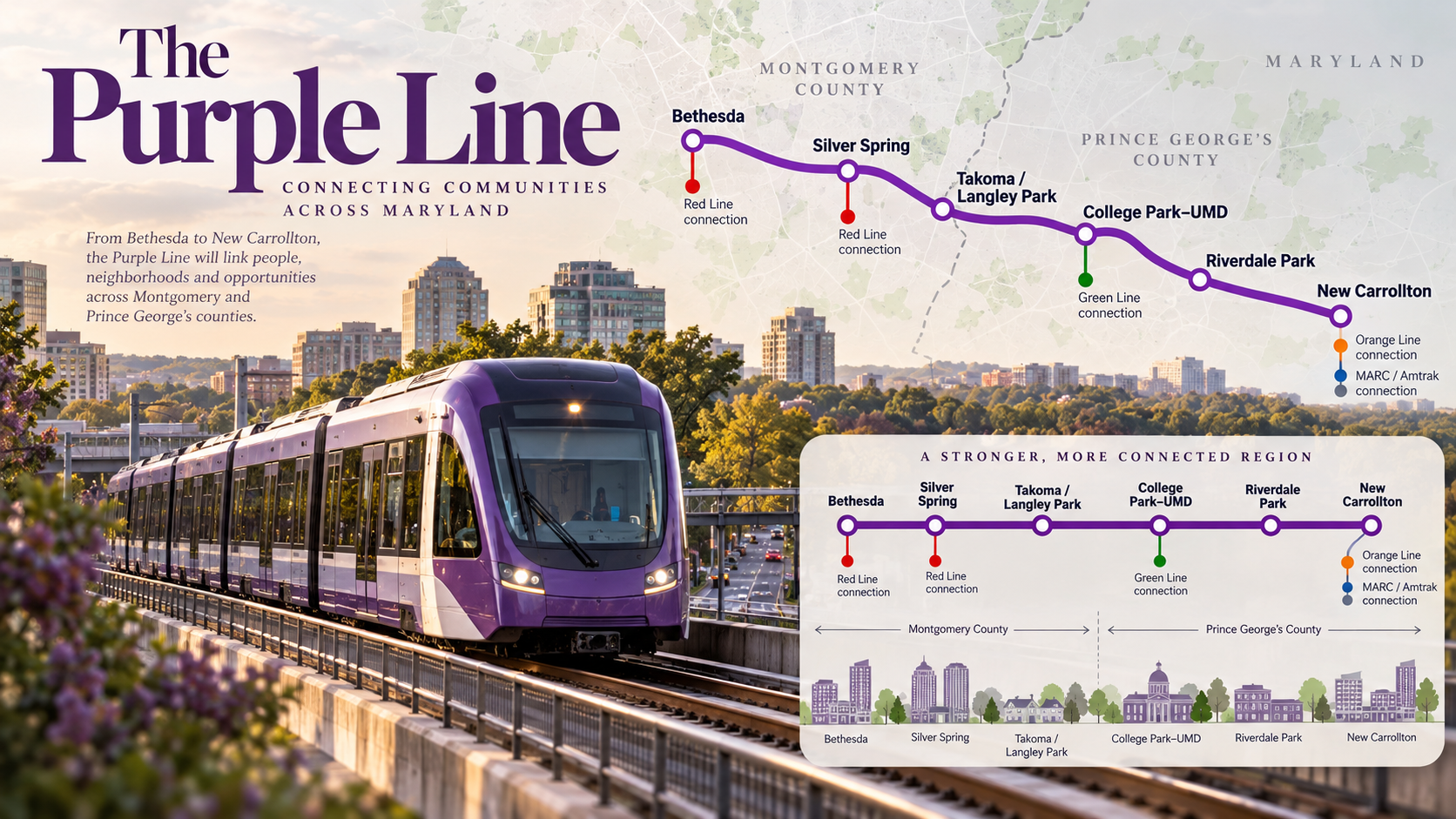
By September 2026, construction on the Purple Line was reported as 92% complete, with light-rail vehicle testing underway across more than half of the roughly 16-mile alignment.
Passenger service is currently expected in late 2027.
The project will ultimately connect Bethesda and New Carrollton through 21 stations while linking communities across Montgomery and Prince George's counties to existing Metro, MARC, Amtrak and local bus service.
For real estate, the important question is not simply whether the train opens.
It is what changes when access changes.
Connectivity
Distance and access aren't the same thing.
Two places can sit relatively close to one another on a map and still feel far apart in everyday life.
Traffic.
Transfers.
Parking.
Road patterns.
Commute reliability.
Those frictions influence how people decide where they are willing to live, work, shop and spend time.
The Purple Line creates a new east-west transit connection through communities that previously depended much more heavily on roads or indirect transit routes.
It will connect directly with Metrorail at Bethesda, Silver Spring, College Park and New Carrollton, while also providing connections to MARC, Amtrak and local bus networks.
That does not erase geography.
It changes how geography is experienced.
“Real estate isn't only about where a property sits.
It's also about what that location connects you to.”
— Lance Hawkins
The Real Estate Question
Access can change how people define a market.
When transportation improves, buyers and renters may begin comparing communities they previously viewed as belonging to completely different search areas.
An employer in Bethesda may feel more accessible from parts of Prince George's County.
College Park may become more connected to Silver Spring.
New Carrollton's existing Metro, MARC and Amtrak connections gain another layer of regional access.
That can influence housing searches, commercial activity and development interest.
But improved transportation does not guarantee appreciation.
Every station area is different.
Existing housing stock matters.
Land availability matters.
Zoning matters.
Walkability matters.
The surrounding retail environment matters.
And the quality of the connection between the station and the neighborhood matters.
A transit project can create opportunity.
It cannot create fundamentals that are not there.
What I'm Watching
The stations are only the starting point.
- 01 · NEW CARROLLTON Already one of the region's most connected transportation nodes, New Carrollton will add Purple Line service to its existing Metro, MARC, Amtrak and bus connections. Watch what improved connectivity means for continued development around the station.
- 02 · COLLEGE PARK The University of Maryland and existing Metro service already create significant activity. The Purple Line adds another connection through a part of the region where students, residents, employees and development already overlap.
- 03 · RIVERDALE + SURROUNDING PRINCE GEORGE'S COMMUNITIES These are places where the transportation story may become particularly interesting because the new line can alter how residents connect east and west without traveling through downtown Washington first.
- 04 · SILVER SPRING Silver Spring is already a substantial employment, residential and commercial center. The question is how another major transit connection strengthens the relationships between Silver Spring and communities farther east.
- 05 · BETHESDA Bethesda demonstrates the other end of the equation: the Purple Line is not simply connecting emerging areas to one another. It is linking them directly to one of the region's most established employment and real-estate markets.
Don't Chase the Map
A station is not an investment strategy.
It is tempting to look at a new transit map and assume every property near every station is automatically an opportunity.
That is too simple.
The more useful questions are:
- How comfortably can residents reach the station?
- What does the surrounding street network look like?
- What development is permitted nearby?
- Is there land available for meaningful redevelopment?
- What businesses and amenities already exist?
- What housing demand already exists?
- And what changes are actually planned versus merely possible?
Transportation deserves to be part of a real-estate analysis.
It should not replace one.
The Agent Lance View
Watch how the search map changes.
The Purple Line interests me because its biggest effect may not be a single project or a single station.
It may be the way people begin thinking differently about what is convenient.
Real-estate searches are often shaped by invisible boundaries:
“I don't want to be that far from work.”
“That area isn't connected enough.”
“I need easier access to Metro.”
When transportation changes, some of those assumptions can change with it.
That is worth watching.
Not because every property along the Purple Line will suddenly become an investment.
But because better connectivity can change which places people are willing to consider.
“Don't just watch where the train stops.
Watch how the places between those stops begin to relate to one another.”
— Lance Hawkins
What to Watch Next
- Continued vehicle and systems testing
- Station completion
- Passenger-service timing
- Station-area development
- New Carrollton development
- Pedestrian connections around stations
- Housing and commercial activity along the corridor
DMV Intelligence is editorial analysis from Lance Hawkins based on publicly available planning information and professional perspective. It is not a prediction of future property values or investment returns.
Back to DMV Intelligence