Investment · Development
DATA CENTERS ARE CHANGING THE LAND CONVERSATION.
What Northern Virginia's digital infrastructure boom means for land use.
Northern Virginia's data-center industry has become too large to think of as merely a technology story. It is increasingly a land-use, infrastructure and real-estate story.
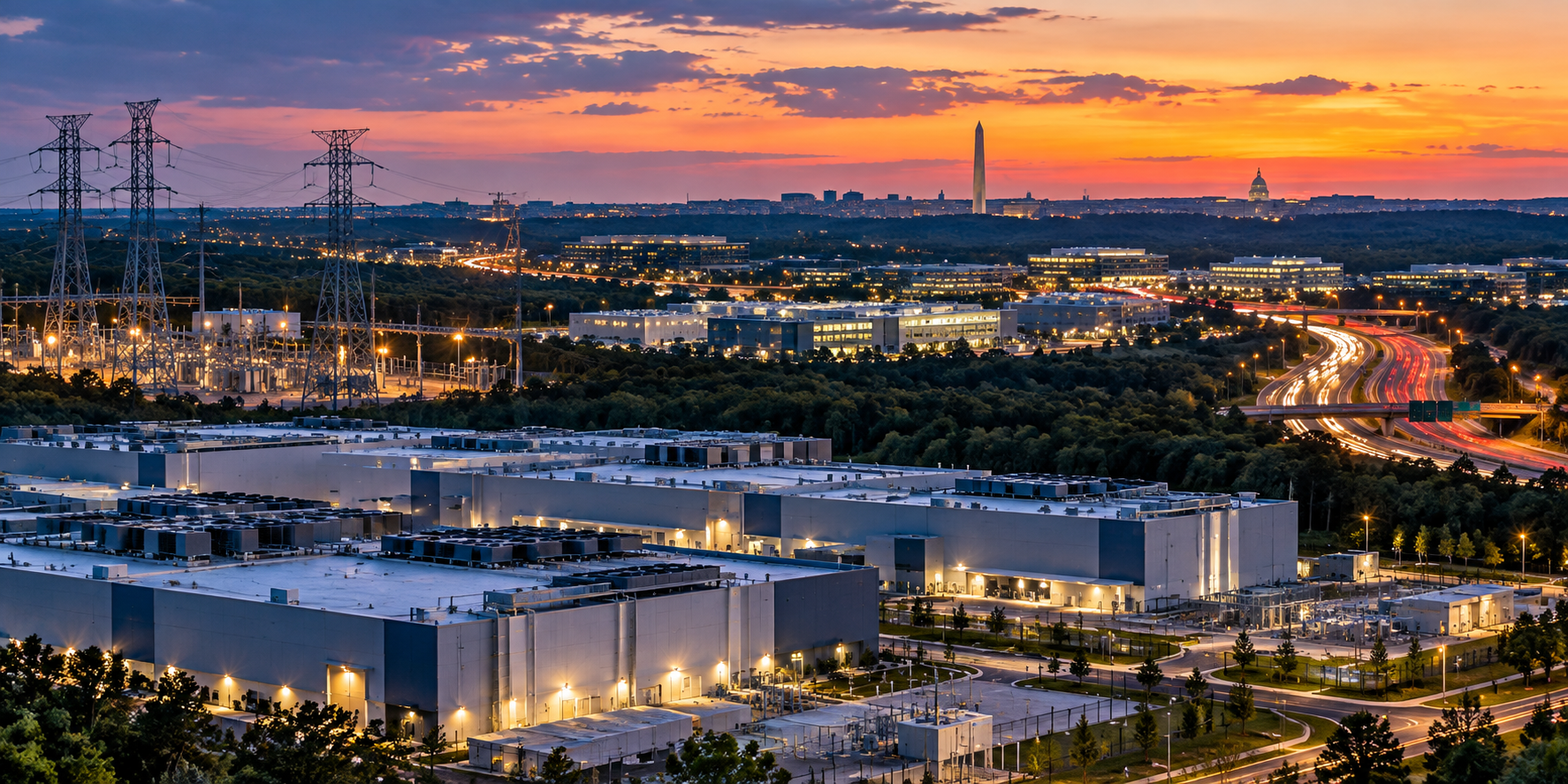
Editorial illustration of Northern Virginia data-center and utility infrastructure.
Northern Virginia's data centers power an enormous amount of the digital world.
But look at the issue through a real-estate lens and another story becomes visible.
Land.
Power.
Zoning.
Setbacks.
Infrastructure.
Tax revenue.
Nearby homes.
Competing development uses.
As of August 2026, Fairfax County reported 20 standalone data centers operating and another 11 under construction.
Prince William County has simultaneously been reconsidering how much land should remain available for future data-center development and under what approval process.
That tells us something important.
Data centers are no longer simply an industrial use tucked into technology parks.
They are helping shape the land-use conversation across Northern Virginia.
The Land Question
Square footage isn't the only resource.
A data-center site needs more than a building pad.
Access to enormous amounts of electricity matters.
Utility infrastructure matters.
Fiber connectivity matters.
Road access matters.
Distance from incompatible uses matters.
And the scale of the campus can matter significantly.
That changes how certain parcels are evaluated.
Land that may once have been viewed through the lens of office, traditional industrial or long-term redevelopment may be analyzed very differently when digital infrastructure becomes a potential use.
For landowners and investors, that can create opportunity.
For nearby residents and local governments, it can create a different set of questions.
Fairfax County
Growth now comes with more rules.
Fairfax County has already responded to the growth of the sector with specific zoning standards intended to address compatibility with surrounding communities.
Current county rules include minimum separation from residential properties, requirements related to equipment placement, noise studies, screening and building design.
The county also restricts data centers near Metro stations.
That policy choice is revealing.
Not every commercially valuable piece of land is viewed as equally appropriate for the same use.
A parcel near transit may have one long-term planning value.
A large industrial parcel near major power infrastructure may have another.
Land-use policy increasingly has to decide between those competing opportunities.
Prince William County
The map itself is changing.
Prince William County has gone even further in reconsidering where future data centers should be permitted.
In September 2026, the Board of County Supervisors adopted changes that restructure and reduce the Data Center Opportunity Zone Overlay District.
The revised approach limits which existing properties remain inside the overlay and closes it to future expansion.
Outside the overlay, many new data-center proposals must now proceed through a Special Use Permit process instead of relying on the previous by-right framework.
That does not mean data-center growth is ending.
It means the approval landscape is becoming more selective.
For property owners, that distinction can materially change how land is evaluated.
“When zoning changes, the dirt doesn't move.
But what that dirt can become may change dramatically.”
— Lance Hawkins
What I'm Watching
The real estate story is bigger than the building.
- 01 · POWER Electrical capacity and new transmission infrastructure will continue to shape where large-scale digital development is feasible.
- 02 · ZONING County decisions about permitted locations can meaningfully alter the development potential of individual parcels.
- 03 · RESIDENTIAL COMPATIBILITY Setbacks, noise, visual impact and proximity to neighborhoods will remain central issues as development expands.
- 04 · LAND VALUES Different potential uses can create dramatically different expectations around the value of land. That does not mean every parcel near a data-center corridor suddenly has data-center value. Entitlements and infrastructure matter.
- 05 · TAX BASE Local governments value the substantial tax revenue generated by data centers, particularly because the facilities contain high-value equipment. That economic benefit has to be weighed alongside infrastructure and land-use considerations.
- 06 · COMPETING USES Industrial development, housing, offices, conservation, agriculture and other uses can all compete for land. The strongest financial use is not automatically the preferred planning use.
- 07 · POLICY This is a fast-moving area of local land-use policy. Today's zoning framework should not automatically be assumed to be tomorrow's.
Investment
Don't buy the data-center headline.
The scale of Northern Virginia's data-center market can make almost any large parcel sound interesting.
That can be dangerous.
A property is not a data-center site merely because another data center exists nearby.
Investors need to understand:
- zoning
- overlay boundaries
- utility capacity
- transmission infrastructure
- environmental conditions
- road access
- setbacks
- nearby residential uses
- entitlements
- and political risk.
Sometimes the most important thing about a parcel is not what sits on it today.
It is what local policy will allow it to become.
The Agent Lance View
Land requires a different kind of reading.
Residential buyers can often begin with a house.
Land investors usually have to begin with a question.
What can this property actually support?
The data-center debate in Northern Virginia is an extreme example of why that matters.
Two parcels can look similar from the road and have entirely different development potential because of zoning, infrastructure, neighboring uses or government policy.
That is why land should never be evaluated on acreage alone.
You have to understand the system around it.
“The more valuable the potential use, the more important it becomes to understand whether the land can actually support it.”
— Lance Hawkins
What to Watch Next
- Fairfax County data-center construction
- Electrical infrastructure
- Prince William overlay implementation
- Special Use Permit applications
- Residential setbacks and compatibility
- Land transactions
- Local zoning changes
- Utility expansion
DMV Intelligence is editorial analysis from Lance Hawkins based on publicly available planning information and professional perspective. It is not a prediction of future property values or investment returns.
Back to DMV Intelligence